Possible ID: Cladosporium sp.
Classification:
Phylum: Ascomycota
Class: Dothideomycetes
Order: Capnodiales
Family: Davidiellaceae
Isolation and Culturing Methods:
This specimen was isolated from soil samples in the Rooke Greenhouse, from a planter pot housing a Chenopodium oahuense plant. The soil was given a Nitrogen/Phosphorus blend four weeks prior to collection, and the greenhouse is kept at 26*C, >20% humidity and nightly UV light treatments. Specimen was grown in malt extract agar + chloramphenicol (MEA+C) for one week at room temperature, then hyphae that were not threatened by contamination were moved to a new sterile MEA+C plate and allowed to grow for another week.
Culture Appearance and Growth:
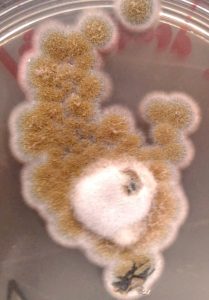
Morphology of these specimens was variable over the course of the five weeks of observation, and the plates appear to have been anamorph and teleomorph separately. In the first two weeks, one plate (presumably anamorph) presented with dense, discrete raised patches with a moss-textured outer layer grew from the center of the plate where hyphae were implanted. Several smaller colonies developed around the larger original colony. Color of the outer layer started as a greyish green, but turned almost completely grey and black by the final observation. Beneath the outer layer, dense black rubbery masses protruded from the agar, sometimes excreting black latex. The second plate (presumably teleomorph) grew very differently. The mold was still very dense, but appeared more “fuzzy” than moss-like in texture. Initial growth started as the same greyish green, but grew rust colored then white from the center of the irregular colony. The white center was raised, but the surrounding mold was relatively flush to the agar. The entire colony also became entirely black and grey by the end of the experiment.
Spore Production:
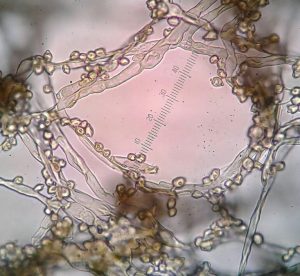
Microscopic images from the teleomorph plate are not available, and reproductive structures aside from spores were not detectable in the anamorph plate. Spores are tan, slightly rugose, fusiform, have an apical pore, and their diameter ranges from 3 and 7 um. Hyphae are septate with no clamp connections, and have a twisted rope-like appearance.
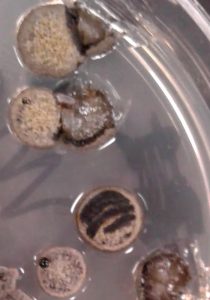
- anamorph
- teleomorph
- anamorph 1000x magnification
***BLAST Analysis Results
Cladosporium sp.
C. halotolerans (98% qc), C. parahalotolerans (98% qc), C. sphaerospermum (99% qc)
Cladosporium sp. are a common mold in and outdoors. They are generally not pathogenic in humans but can lead to skin, nail, and nasal infections, and spores can trigger environmental allergy symptoms.